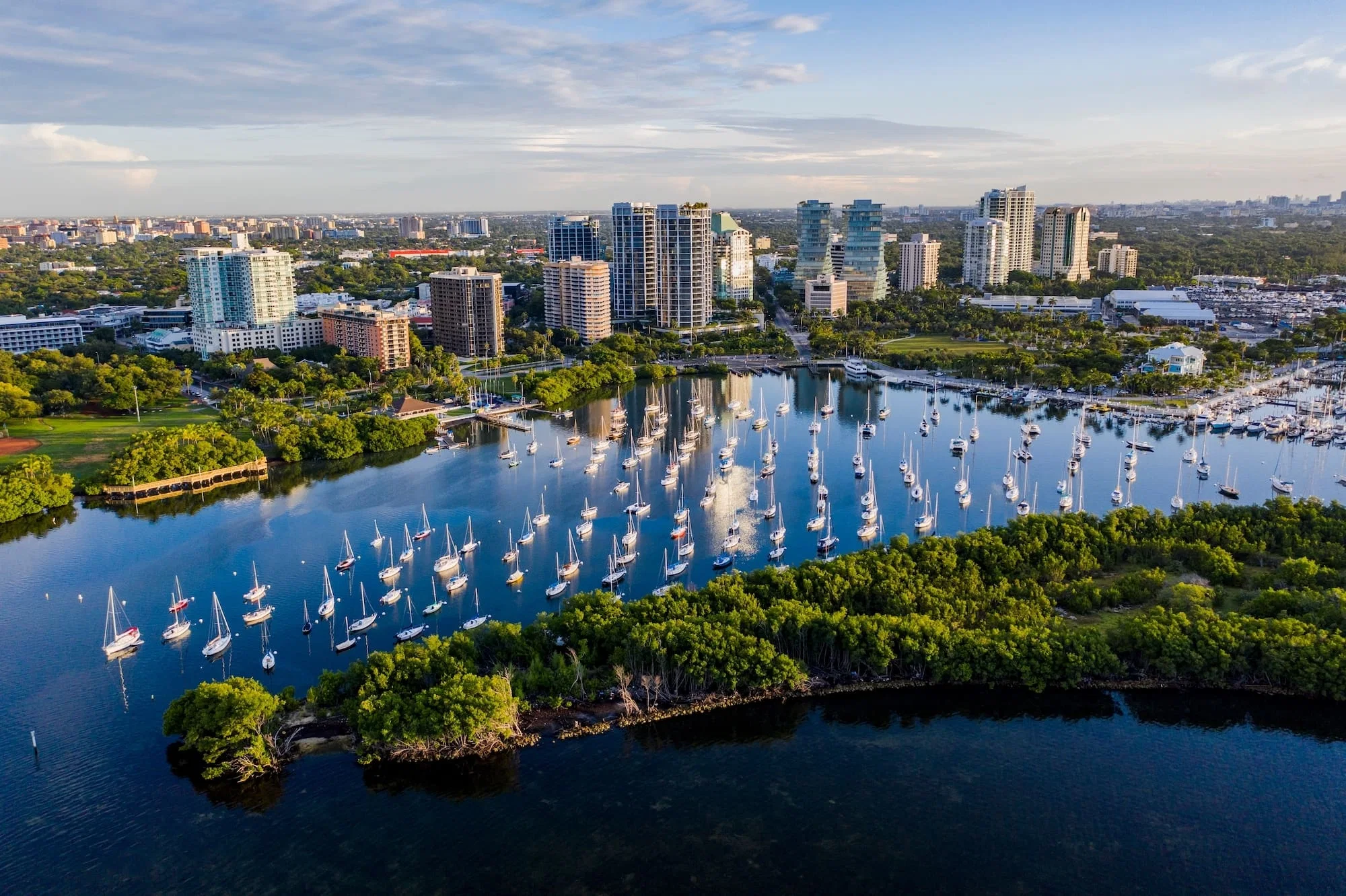
Core Coordination Factors for Coconut Grove Exhibitions
Integration with Miami Airport Convention Center’s 172,000 square feet that includes 100,000 square feet of exhibition area
Utilization of Broward County Convention Center’s 350,000 square feet of contiguous exhibit space for overflow capacity
Assembly of services through the GMCVB supplier categories covering AV, catering, DMC, transportation, and staffing
Adherence to venue-specific exhibitor manuals that dictate labor, loading, and contractor protocols
Management of freight timing and neighborhood routing between districts and primary venues
Coordination of exhibitor-appointed contractors under show-specific and property-specific rules
Coconut Grove in the Regional Trade Show Landscape
Within the documented Miami-Dade and Broward operating region, Coconut Grove operates as a secondary district that supports extensions of larger programs anchored at the primary convention centers. Demand generated by the Miami Beach Convention Center and the airport facility routinely distributes into surrounding neighborhoods for off-site functions, executive briefings, and experiential components. The official notes on South Florida venue strategy confirm that the two counties function as one connected market for major shows, overflow activity, incentive gatherings, and resort-based activations. This framework gives planners the latitude to situate targeted programming in Coconut Grove while retaining access to the full inventory of exhibit and meeting space across the ecosystem.
District differentiation becomes evident in the distinct routing patterns and access considerations that separate Coconut Grove from Brickell, the Design District, Wynwood, or Edgewater. Where downtown corridors emphasize high-density logistics, Coconut Grove’s layout introduces different timing requirements for deliveries and personnel movement. These nuances are addressed through advance mapping of freight paths from major highways to neighborhood venues and onward to the convention floors. The approach avoids generic descriptions and instead focuses on operational realities that affect drayage schedules, installation windows, and dismantle timelines.
Planners treat Coconut Grove as an extension of the beach convention core rather than an isolated market. This perspective is reinforced by the Greater Miami Convention and Visitors Bureau’s resources, which position the entire area as a unified meetings destination. The result is a planning discipline that begins with venue specifications and works outward to incorporate the unique characteristics of each participating district.
Venue Specifications That Drive Regional Planning
The Miami Beach Convention Center remains the scale leader with 1,400,000 total square feet of meeting and event space. Its nearly 500,000 square feet of exhibit space can accommodate large-format trade shows whose ancillary events can be distributed to districts such as Coconut Grove. The facility’s 60,000 Square Foot Grand Ballroom and 20,000 Square Foot Junior Ballroom support gala and plenary functions, while the 84 breakout rooms enable concurrent programming that may draw participants from multiple neighborhoods. Official listings emphasize the center’s sales and services team as a central resource for contracting, room blocks, and logistics coordination.
Complementing this capacity, the Miami Airport Convention Center supplies 172,000 square feet configured for conference, trade show, and meeting use. The 100,000 square feet of dedicated exhibition space, 29,000 Square Foot ballroom, and 45 breakout rooms make it a practical choice for events with significant air-travel components. Its location west of downtown creates efficient connections to southern districts including Coconut Grove and Coral Gables, reducing transit times for staff and materials moving between exhibit halls and satellite locations.
Broward County Convention Center functions as the primary overflow resource with 350,000 square feet of contiguous exhibit space and an additional 31,639 Square Foot meeting venue. Expansion language on the official site indicates future growth beyond 1.2 million square feet, further solidifying the depth available to planners operating across the two-county region. These specifications allow programs that begin in Miami Beach or at the airport to expand northward without sacrificing continuity in labor, freight, or supplier arrangements.
Miami Beach Convention Center: 1,400,000 square feet total meeting space
Miami Airport Convention Center: 45 breakout rooms and 29,000 Square Foot ballroom
Broward County Convention Center: documented plans for campus growth above 1.2 million square feet
All facilities operate under individual exhibitor manuals that govern on-site services
Supplier Network and Specialized Service Coordination
The official GMCVB supplier directory organizes resources into discrete categories that enable planners to construct a complete operational team tailored to each event’s technical, logistical, and creative requirements. Audio-visual and film services, professional caterers, destination management companies, transportation fleets, employment agencies, and entertainment booking agents appear as standalone segments. This structure reflects a market that depends on outside expertise rather than universal in-house provisions at every venue.
When coordinating for Coconut Grove activations that run parallel to a main exhibit program, planners draw from these categories to secure compatible partners whose equipment and personnel can move efficiently between districts. A DMC may handle airport transfers and neighborhood shuttles while an AV provider equips both the primary hall and the secondary location. Employment services can supply supplemental staffing that complies with the show’s specific labor instructions. The breadth of the directory reduces single points of failure and supports the mixed-vendor model that characterizes South Florida events.
High-quality suppliers in these categories routinely collaborate on complex programs that span multiple days and multiple sites. Their documented ability to deliver consistent execution across the Miami-Dade and Broward continuum gives planners confidence when designing hybrid schedules that incorporate Coconut Grove’s distinct environment alongside the scale of the beachfront and airport facilities.
Audio-visual and film services
Catering and culinary partners
Destination management companies
Transportation and logistics providers
Employment and staffing services
Entertainment and talent booking
Venue-Specific Labor Positioning and Compliance
Labor and service rules in the South Florida market are established property by property rather than through any blanket regional policy. The Miami Beach Convention Center, Miami Airport Convention Center, Broward County Convention Center, and supporting venues each maintain individual guidelines that appear in the current exhibitor manual. These documents detail which tasks fall under house labor, which may be performed by exhibitor-appointed contractors, and which require union or venue-approved personnel. Planners review the manual for each show and each venue before finalizing staffing plans.
The mixed model permits outside vendors in many categories when the show organizer and the facility both authorize their presence. Audio-visual crews, specialized riggers, and certain display installers frequently operate under exhibitor-appointed contractor status, provided all documentation is current and all safety protocols are observed. Employment services listed in the GMCVB directory can supply additional personnel who are then integrated according to the live event paperwork. This approach avoids assumptions about open or restricted labor and instead grounds every decision in the specific manual in force for that program.
Coordination therefore includes early dialogue with the Convention Sales and Services team at the Greater Miami Convention and Visitors Bureau as well as direct consultation with each venue’s operations staff. The goal is uninterrupted compliance that protects both schedule and budget while respecting the documented labor realities of the South Florida meetings industry.
Operational Details: Routing, Freight, and Contractor Coordination
Neighborhood routing, loading realities, and freight timing constitute central planning concerns when events cross district boundaries. Coconut Grove’s street network and proximity to major arteries require separate scheduling logic from the denser corridors of Brickell or the industrial access points near the airport. Advance mapping of permitted delivery windows, temporary storage locations, and return routes prevents conflicts with residential traffic patterns and other concurrent events.
Exhibitor-appointed contractors must be cleared through the show organizer and the host venue before materials arrive. Their scope of work, insurance certificates, and safety credentials are reviewed against the property’s current manual. Once approved, these contractors coordinate with house labor for tasks that straddle the boundary between outside and venue-controlled services. Precise timing of move-in, installation, exhibition hours, dismantle, and move-out becomes essential to maintain the overall program calendar across the connected Miami-Dade and Broward market.
Venue-specific services further differentiate one property from another. Some facilities provide on-site rigging crews while others require certified outside riggers. Certain ballrooms accept only particular floor coverings or electrical configurations. Planners catalog these requirements during the initial site selection phase so that exhibit designs and logistical plans remain compatible from the first drawing to final teardown.
District-specific freight routing from interstate to venue loading docks
Exhibitor-appointed contractor approval workflows per exhibitor manual
Staggered installation schedules to align with multiple concurrent events
Documentation of all safety and insurance requirements before move-in
Linking Coconut Grove to Complementary Miami Districts
Coconut Grove shares the South Florida event economy with a defined set of neighboring markets that together cover the beach convention core, downtown and airport belts, design-oriented zones, and northern coastal resort areas. Recommended planning connections include Downtown Miami, Brickell, Wynwood, the Miami Design District, Midtown Miami, Edgewater, and Coral Gables. Each district presents its own operational signature while remaining within easy reach of the Miami Beach Convention Center and the Miami Airport Convention Center.
Programs frequently combine a main exhibition at one of the large facilities with evening receptions or breakout sessions in Coconut Grove. The transportation segment of the supplier network supplies the shuttles and executive vehicles that keep attendees moving on schedule. Destination management companies coordinate the thematic elements that differentiate a Coconut Grove function from a similar event staged in South Beach or Bal Harbour. This layered approach maximizes the documented venue depth while respecting the distinct character and logistics of each location.
Long-range calendars maintained by the Greater Miami Convention and Visitors Bureau help planners avoid date conflicts across the region. By treating the thirty-eight documented markets as an integrated whole, coordinators can allocate space, labor, and services with greater precision and fewer last-minute adjustments.
Downtown Miami and Brickell for corporate daytime programming
Wynwood and Miami Design District for creative and experiential extensions
Coral Gables and Key Biscayne for hospitality and incentive components
Miami Beach and South Beach for large-scale evening events
Strategic Planning Practices for Sustained Success
Effective trade show coordination in Coconut Grove begins with a comprehensive review of all relevant exhibitor manuals and show specifications at least six months prior to move-in. This timeline allows sufficient opportunity to secure preferred suppliers from the GMCVB directory, confirm contractor approvals, and map freight routes that account for seasonal traffic patterns across Miami-Dade County. Early engagement with the Convention Sales and Services team provides access to updated venue policies and regional insights that influence final event design.
Exhibit strategies are developed in parallel with logistical plans so that booth dimensions, graphics, and interactive elements remain compatible with both the primary hall and any Coconut Grove satellite spaces. Attention to electrical requirements, internet bandwidth, and climate control at each location prevents costly on-site modifications. The mixed labor model is documented in the project brief so every stakeholder understands which tasks are handled by house crews and which fall to outside specialists.
Post-event reviews capture lessons on routing efficiency, contractor performance, and supplier responsiveness. These observations refine future programs and contribute to the cumulative knowledge base that distinguishes experienced South Florida planners. The approach remains grounded in the official venue data, supplier listings, and operational notes rather than promotional generalizations, ensuring every recommendation stays tethered to documented regional capacity and practice.
Frequently Asked Questions on Coconut Grove Trade Show Planning
Q: Which major venues support exhibitions connected to Coconut Grove, Florida?
Primary venues include the Miami Beach Convention Center offering 1,400,000 square feet of meeting space and 500,000 square feet of exhibit space with 84 breakout rooms, the Miami Airport Convention Center with 172,000 square feet that includes 100,000 square feet of exhibition space and 45 breakout rooms, and the Broward County Convention Center supplying 350,000 square feet of contiguous exhibit space plus expansion plans above 1.2 million square feet.
Q: How does the GMCVB supplier directory assist with Coconut Grove events?
The directory organizes resources into dedicated categories for audio-visual and film services, caterers, destination management companies, transportation, employment services, and entertainment booking. This structure enables planners to assemble a network of specialized vendors whose capabilities align with both main-hall exhibitions and district-level activations.
Q: What labor model applies to trade shows that include Coconut Grove?
Labor follows a venue-driven, mixed model governed by each property’s current exhibitor manual and the show organizer’s specific instructions. House services and approved outside contractors operate under documented rules rather than any universal open or restricted policy across South Florida.
Q: Why is district-level differentiation important for Coconut Grove planning?
Each Miami neighborhood presents unique routing, loading, and timing considerations that differ from those in Brickell, Wynwood, or the Design District. Advance attention to neighborhood-specific freight paths, contractor clearance, and venue hand-off protocols prevents delays and maintains schedule integrity across the connected Miami-Dade and Broward region.
Q: How are Miami-Dade and Broward County treated for event coordination?
Official planning resources treat the two counties as a single connected operating region. This allows smooth movement of exhibits, personnel, and suppliers between the Miami Beach Convention Center, the airport facility, Broward overflow venues, and district locations including Coconut Grove.
Q: What operational elements require earliest attention?
Freight timing, exhibitor-appointed contractor approvals, loading dock reservations, and alignment with each venue’s specific services should be confirmed during the initial planning phase. These details are drawn directly from the property manuals and GMCVB supplier listings.